

Internet Psychopaths - Part 1: The Obsessive
The dangers of being too online and the reality of internet clout.

The internet is a beautiful place for self-expression. When it’s used correctly, it’s a blank canvas to express your most raw thoughts, frustrations, passions, shitposts, and the depths of your insanity. If you use it anonymously, you’re able to express yourself freely even more-so.
The internet isn’t going anywhere, but it’s become pretty cooked lately. The “world wide web” is irrelevant and often unusable. News sites have lost all legitimacy and social media has become a slop-fest. With the birth of AI and the renewed freedom of speech on X, the internet is going through a transition. Either the social aspect of the internet will become worse and people will spend less time online, or it will get better. But for now, it’s pretty cooked. We’ll see where it goes.
Many see the internet as a net-negative on society because of how it affect’s people’s personalities and how it harms socialization. And while that’s true, I see it as a good thing. Not everyone is chronically online. Not everyone is addicted to porn. Those with the ambition to lead a fulfilling life in the real world will find a way to balance being online and “touching grass.” Those who got pulled into the void and became internet creatures weren’t going to make it in the first place. Nature has an efficient way of unraveling things for what they truly are.
Internet Psychopaths
There’s too much I can say on this topic and I want to do so without talking about myself too much. As the most hated man on the sometimes funny, sometimes intelligent, but often very gay corner of X known as “Right Wing Twitter”, I have more Internet Psychopaths in my notifications within one hour than most will see in their entire lives.
It’s hard to say who is and isn’t a psychopath by internet standards. Some people are just losers with nothing to do. They’ve got nothing going on. They’re bored, and they’re angry that they’re bored, but they’re not necessarily psychopaths. There are of course true psychopaths online, but they’re pretty rare. Most people on social media are lurkers. On the internet, psychopathy tends to manifest itself in groups. Collective psychosis. You see this most often when everyone is ganging up on someone else or endlessly talking about the same thing.
The DSM-IV’s rough definition of a psychopath is someone with a pervasive disregard for and violation of the rights of others, and nowhere else is that easier to do than on the internet. Most people are cowards in real life and avoid confrontation at all costs. Online, however, they can let their dark side reveal itself with little to no consequences. In this post I’m going to talk about what causes internet psychopathy, how to spot an internet psychopath, and how to avoid becoming one.
Most People Have No Friends
When it comes to social connectivity, we live in a barren world — this is especially the case in America, the first nation to throw a ton of ethnicities into the same pot and see what happens. Generally, you have two chances in life to create a solid social network IRL: at school then at work. If it doesn’t work out, you can find “friends” online. I put friends in air quotes for a reason — more on that later.
With each passing generation, more and more people have reported to not have a best friend. I cannot emphasize how important it is to have a best friend to relate to, rely on, and ultimately trust with your life. Even worse, a lot of people, men especially, report to not have any friends at all, oftentimes to no fault of their own. It’s just harder to make friends in the world we live in. When it comes to in real life socialization, we live in the loneliest version of America to ever exist.
Internet Friends Should Seldom Be Trusted
Again, I’m not going to talk too much about myself, but I’ve been back-stabbed by enough “friends” online to know that they’re usually not your real friends. You’re entertaining them while they’re bored, and vice versa usually. Even if you meet in person, that doesn’t guarantee a solid foundation of trust. I say this because I’ve been betrayed by people I’ve met online after the fact so they can gain a bit of social clout or like reactions in group chats. It’s extremely disappointing.
That being said, I’ve made a few friends online who I would kill for, and vice versa — but they’re extremely rare and they piss off just as many people as I do. I don’t trust people who care too much about what people think.
Internet Clout Is Real
I know I’m speaking from a pretty unique perspective. In the very small world that is Right Wing Twitter, I have internet clout. Am I proud of this? Not necessarily. RW Twitter is pretty gay now. It used to be great, but it’s devolved significantly. I’m a big heterosexual fish in a very homosexual pond.
What does internet clout translate to? It means when I follow someone, they follow back. If I DM someone, they answer immediately, then they tell their friends about it. When I make fun of someone, it upsets them, because I can reach a lot of people at once and my followers will take my word over theirs. I can nuke people’s reputations whenever I want to, if I feel like it. I try not to take advantage of it. But I’m not going to lie, it’s pretty great.
This, of course, comes with many downsides. At any given point, there’s 4-5 grown men who are obsessed with every detail about my life. They gossip about me all day in group chats. They DM egirls to “warn” them about me. The second they hear a rumor about me, they post it immediately as if it’s verifiable fact and then their followers believe it blindly. A very low IQ cycle. Many anons, some of whom you probably follow, have been laser-focused on doxxing me for years. I’m a permanent fixture that exists in their subconscious and I haunt them unintentionally. I never think about these people, but they think about me every day.
Don’t underestimate how real the internet social hierarchy is. Most people care more about being accepted by the wider group than maintaining friendships. Most people are cowards, and nowhere is that more true than on social media.
The Danger of Being “Too Online”
I hope I didn’t mislead you with ‘Internet Psychopathy’ as the title. It would require a full case study to cover all of the different types of Internet Psychopaths out there. Perhaps this will be a series — but for now I’m going to talk about the most visible type of internet psychopathy, The Obsessive. The Obsessive spends their entire life on the internet and becomes fixated on things or people they have no control over.
I’m not necessarily against people having an online-only social group. Normies can be pretty boring. I can’t talk to my oldest friends about everything I say online because it’s just too far outside the Overton Window for them. But they would give me the clothes on their back if I needed them to and vice versa. We’ve seen each other at our best and worst moments. There’s history and substance that holds us together. It’s not impossible to find something like that with someone online, but speaking from experience — it’s quite rare.
From what I’ve seen, most online friendships end up evolving into group chats with like-minded people, which end up devolving into gossip dens about posters they don’t like. Even if you’re not using the internet for socializing, plenty of Boomers and Gen X’ers become Obsessives themselves. The crazy aunt who can’t stop posting about politics on Facebook is no less deranged than the Zoomer or Millennial who can’t stop posting about (insert well-known poster here), The Jews, The Longhouse, etc.
The one thing they have in common is they direct their mind and soul towards something outside of themselves to avoid feeling uncomfortable emotions and thinking about their own lives. They’re unstable and unreliable.
Online-Grass Balance
I don’t know the ins and outs as to why these people become Obsessives. Everyone’s story is different. But one thing is for sure — your phone is a dopamine machine. This is so well-known and so obvious that it’s basically a meme, yet everyone ignores it.
There isn’t too much you can personally do about Obsessives, or anyone else online, other than mute or block them. If you notice a friend online is fixated on a particular topic, thinks in binary terms, or spread rumors about people — slowly back away. They’re not your friends and they’re not capable of being anyone’s friend.
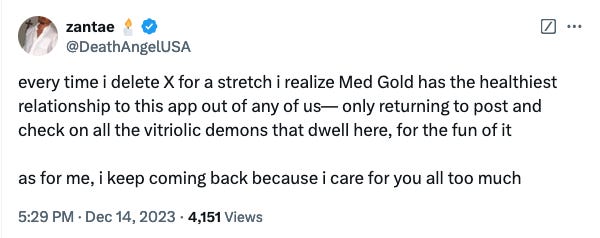
I take breaks from social media a few times a year. Sometimes it’s for a weekend, sometimes it’s for a few months at a time. And I never regret it. I always feel good when I’m offline. I don’t feel worse when I reactivate, but I’m able to see psychopathy for what it is with clearer eyes. I don’t get pulled into every piece of ragebait, TikTok Slop, and stupid online obsession with online personalities I don’t even know. Spending time offline never does anyone harm. If you haven’t in a while, I strongly recommend taking some time off for the holidays. Whether or not you like your family, disconnecting for a bit and being more present will only make you more aware of yourself and what you might be avoiding. I don’t guarantee a lot of things, but I can guarantee you won’t regret it, and when you come back online, you’ll be significantly less psychopathic than you possibly once were.
The best part is, randoms DM'ing e-girls to "warn" them about you will just boost their interest. Lol.
"Tell her I'm an asshole and she should stay away. It will just make her like me more" -Tucker Max
Thank you for giving me the comp I needed to read this